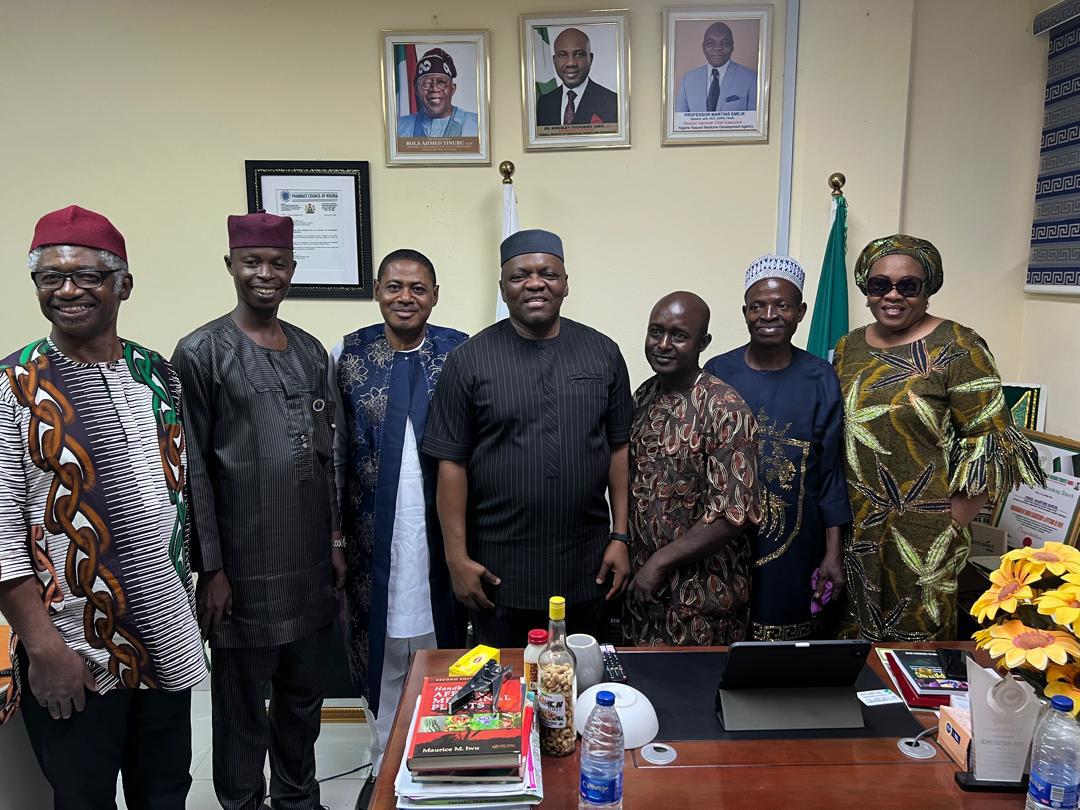
Executive members of three leading professional bodies in the traditional, complementary and integrative medicine space have paid a congratulatory visit to the Director General/Chief Executive Officer of the Nigeria Natural Medicine Development Agency (NNMDA), Prof. Martins Emeje, following his appointment as Co-Chair of the World Health Organization (WHO) Strategic and Technical Advisory Group on Traditional, Complementary and Integrative Medicine (STAG-TM).
The visiting associations include:
- Association of Integrative Medicine Practitioners (AIMP)
- Association of Professors and Consultants of Traditional, Complementary and Integrative Medicine (APCTCIM)
- West African Postgraduate College of Natural and Integrative Medicine (WAPGCNIM)
The delegation described the appointment of Prof. Emeje as a well-deserved global recognition of Nigeria’s growing leadership in traditional medicine research, regulation, and policy development, as well as a testament to his visionary leadership style.
Speaking on behalf of the visiting associations, the executives commended the Director General for his sustained efforts in strengthening scientific research, innovation, standardization, and international collaboration in natural medicine development. They noted that his new role at the WHO provides a strategic platform to amplify Africa’s voice in shaping global policies on traditional, complementary and integrative medicine.
According to the delegation, Prof. Emeje’s appointment is not only a personal achievement but also a significant milestone for Nigeria, West Africa, and the African continent, particularly at a time when traditional medicine is gaining renewed global relevance in achieving universal health coverage and sustainable development goals.
Prof. Martins Emeje expressed appreciation to the associations for the visit and their continued partnership with the Agency. He reaffirmed NNMDA’s commitment to fostering collaboration among practitioners, academics, researchers, and policymakers to ensure that traditional medicine in Nigeria is safe, effective, evidence-based, and globally competitive.
He further emphasized that Nigeria, through NNMDA, remains dedicated to aligning national initiatives with international frameworks championed by the WHO, while promoting indigenous knowledge systems, innovation, and capacity building in the traditional and integrative medicine sector.
The associations pledged to strengthen cooperation in research, training, policy advocacy, and professional development, in line with national priorities and global best practices.
toto togel